
The problem you see is not always the problem you should solve.
Declining sales, falling productivity, team misalignment, delays in execution, or repeated mistakes — these may be symptoms of a problem, not the problem itself. UM Diagnosing Agent™ helps you move from what’s happening to why it’s happening.

Why diagnosis matters in business.
Many business problems begin with a visible symptom — but their source may be elsewhere.
You may see declining sales — but the real issue might be in customer experience, the sales process, value proposition, or cross-team alignment.
You may see declining team performance — but the cause isn’t necessarily motivation or ability. Unclear responsibilities, conflicting goals, or process gaps may play a bigger role.
Without accurate diagnosis, even a good solution can target the wrong problem — wasting resources and leaving you to face the same issue in a new form.
Five things this agent does — to help you diagnose with precision.
Examining Symptoms & Formulating the Problem
Helps you distinguish between what you observe and the problem that truly needs investigation — moving it from vague and general to clearer and reviewable.
Investigating Probable Root Causes
Instead of stopping at the first explanation, you examine various factors that might play a role. The goal is to get closer to the source — not just name what’s on the surface.
Examining Relationships Between Influencing Factors
Business problems rarely occur in isolation. The agent helps examine connections between factors — so you can better understand the mutual influence of processes, decisions, structures, and conditions.
Distinguishing Cause, Symptom & Amplifying Factor
Not all factors play the same role. Some are symptoms, some contribute to the problem, and some make conditions worse. This distinction gives you a more accurate picture.
Identifying Ambiguities & Diagnostic Needs
Not every problem can be diagnosed with initial information alone. Where data is insufficient or explanations conflict, ambiguities are flagged — so the review doesn’t proceed on unverified assumptions.
See beyond the symptoms.
Symptoms, probable causes, and amplifying factors — organized into one diagnostic view.
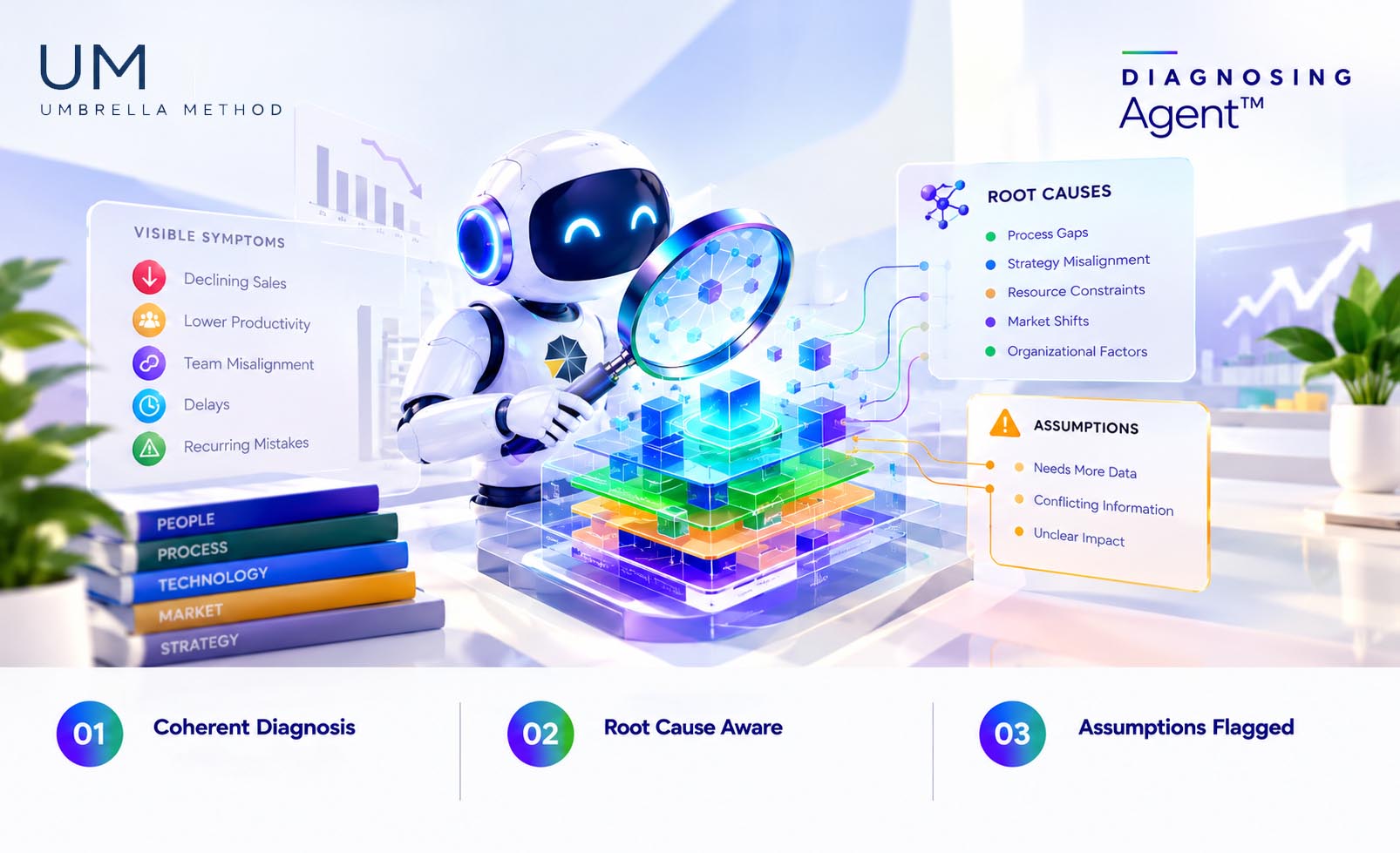
From surface symptoms to deeper structures.
See probable causes — not just the first explanation.
What needs more investigation is clearly marked.
For those facing a problem — without full certainty about its source.
UM Diagnosing Agent™ can help managers, founders, business owners, and consultants. It’s designed for situations where:
A problem repeats — even after corrective actions have been taken.
Multiple symptoms exist — but the connection between them isn’t clear.
Teams have different perceptions of the root cause.
Decisions are made based on guesses, limited experience, or the first available explanation.
Before choosing a solution, you need a more precise problem definition.
A clearer, more structured picture of the problem.
Depending on the information provided and the nature of the problem, the diagnostic process can lead to the following outcomes:
More Precise Problem Definition
Move the problem from vague to clear and reviewable.
Symptoms vs. Probable Causes
Separate what’s visible from what may be underneath.
Influencing Factors & Relationships
See which factors interact — and how.
Assumptions Needing Review
Clearly identify what still needs verification.
Diagnostic Ambiguities
Where information is missing, clearly flagged.
Foundation for Next Decisions
A clearer base for deciding on next steps.
Step 3 of Umbrella Method™ — the stage of diagnosis.
In this architecture, diagnosis is the bridge between seeing your business as a system and deciding where to align or prioritize. This stage ensures the next steps are based on a precise understanding of the actual problem — not on surface symptoms.
In the UM approach, identifying the problem and designing the solution are two different stages.
- Understanding the problem
- Investigating probable root causes
- Distinguishing cause from symptom
- Clarifying ambiguities and unknowns
- Prescribe solutions without sufficient understanding
- Design corrective action plans
- Prioritize changes
- Judge performance or people
Real businesses, real clarity.
“We were sure our problem was pricing. The agent showed us it was actually a sales handoff issue. Completely changed our direction.”
“For the first time we could separate what we were seeing from what was really happening. This diagnosis saved us months of trial and error.”
UM Diagnosing Agent™
Move from symptoms to probable root causes — with a structured diagnostic process.