
From understanding your business to seeing its complete system picture.
UM System Mapping Agent™ transforms your business information into a structured map of its system — showing how the components of your business are organized, what relationships they have with each other, and how they function together.

When you know the components — but can’t see the full picture.
You may have a lot of information about your business — from organizational structure and people’s responsibilities to processes, resources, customers, and daily activities. But knowing these components separately doesn’t necessarily mean understanding the connections between them.
Organizational structure may be clear — but the real relationships between units may not be clearly visible.
Processes may be defined — but the dependencies between steps and activities may not be clear.
Responsibilities may be assigned — but the interaction between people and units may not have a clear picture.
Resources and activities may be known — but their place in the overall business system may not be visible.
Turning information into a map of your business system.
The mapping agent reviews and organizes the structured information from the understanding stage — so the main components of your business and the connections between them can be reviewed in one map. This process focuses on six key dimensions.
Organizational Map
Displays organizational structure, units, roles, and their place in the business system.
Reporting Map
Shows reporting relationships, communication paths, and formal connections between roles and units — based on available information.
Functional Map
Identifies the main business functions and how activities and responsibilities are distributed across different parts.
Process Map
Displays activities, the sequence of steps, and the connections between processes — based on collected information.
Resource Map
Shows identified human, operational, and other resources — and their connection to activities and parts of the business.
Dependency Map
Displays dependencies between components, activities, units, and resources — showing what each part’s performance depends on.
See your business structure, on one page.
Organizational, functional, process, resource, and dependency maps — organized in one coherent system view.
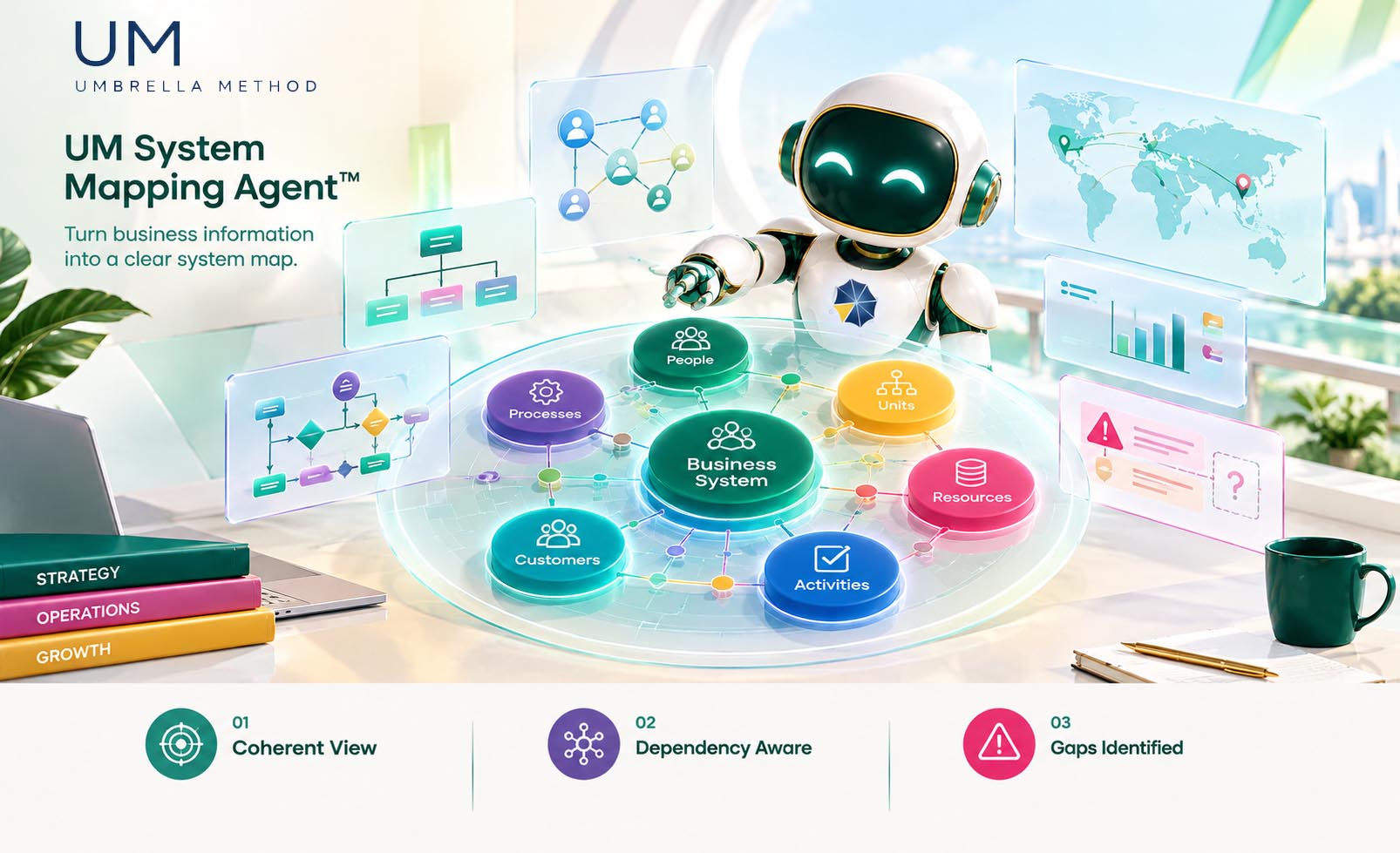
One picture instead of scattered diagrams.
See what each part depends on.
Where information is missing, clearly marked.
From business information to a system map.
Receiving Information
The agent uses the structured business model prepared in the understanding stage. If needed, additional information and ambiguities affecting the mapping are identified.
Identifying System Components
People, units, activities, processes, resources, and other elements related to business structure are identified and categorized.
Mapping Relationships & Dependencies
Connections between components, interaction paths, activity flows, and identified dependencies are organized.
Compiling the System Map
Information is presented in a structured model of the business system — so relationships between components can be observed and reviewed.
Identifying Ambiguities
Items with insufficient information for accurate mapping are marked as ambiguities or areas needing further investigation — not filled in with unverified assumptions.
A structured picture of how your business is shaped and connected.
The output of UM System Mapping Agent™ helps you review your business structure in a more coherent way.
Business System Map
The macro map of the business system and its main components.
Organizational & Functional Maps
Map of organizational structure and business functions.
Process Maps
Map of processes and connections between activities.
Resource & Dependency Maps
Map of resources and dependencies between system components.
Relationships & Flows
Display of relationships, interactions, and identified flows.
Mapping Gaps
List of ambiguities, incomplete information, and relationships that need further investigation.
Step 2 of Umbrella Method™ — the stage of mapping.
The Umbrella Method™ examines a business through eight independent yet interconnected stages. In this journey, each agent has a clear mission and prepares its output for the next stage.
In this architecture, the mapping agent is the bridge between understanding the business and diagnosing its problems. This stage ensures that subsequent reviews are based on a structured picture of the system — not on scattered impressions.
Mapping the system — without prejudging its problems.
To reach an accurate understanding of the business, we must first separate its structure and relationships from evaluation and judgment about its performance.
- Maps the existing structure and relationships.
- Displays identifiable dependencies and flows.
- Identifies ambiguities and insufficient information.
- Distinguishes between confirmed information and relationships needing investigation.
- Diagnose root causes of problems.
- Judge the performance of people or units.
- Determine corrective priorities.
- Design solutions.
For those who need a more structured understanding of their business.
Founders and business managers seeking a more coherent understanding of their activity structure.
Operations managers who need to review connections between units and processes.
Management and business development consultants who need a structured model of the system for further analysis.
Organizational transformation teams who want to document existing structure and dependencies before planning changes.
Growing businesses that, with an increase in the number of people, units, and processes, need a clearer map of their system.
Real businesses, real clarity.
“We could finally see how our teams actually depend on each other. The map changed how we plan operations.”
“We thought we knew our structure. Seeing it mapped showed us three dependencies we’d completely missed.”
UM System Mapping Agent™
Turn your business information into a structured map of its system.